
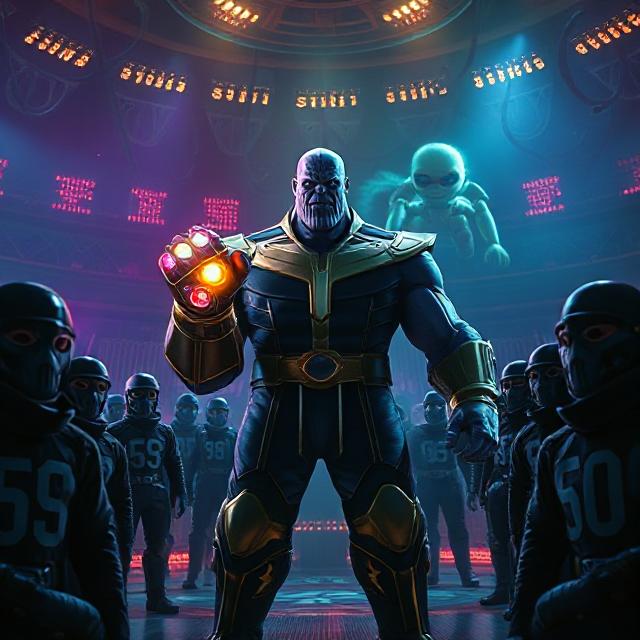
What would happen if the universe’s most feared villain, Thanos, were to step into the twisted world of Squid Game? The concept of Thanos Squid Game brings together two of the most iconic elements of modern pop culture: Marvel’s all-powerful Mad Titan and Netflix’s dystopian survival game. Both are defined by themes of power, morality, and survival — yet they approach them from entirely different angles. Thanos believes in order through destruction, while Squid Game thrives on chaos disguised as fairness.
In this imagined universe, the idea of Thanos Squid Game merges cinematic storytelling with psychological warfare. It explores what would happen if Thanos had to play by someone else’s rules — rules that even he couldn’t bend with the snap of his fingers. As fans, it’s a chance to examine the deeper philosophical implications of what happens when unstoppable power meets inescapable mortality.
This concept has inspired fan theories, digital art, and online discussions about how Thanos’ moral code would clash with the cold logic of Squid Game. To understand this crossover fully, we must first explore the philosophies and motivations behind both Thanos and Squid Game.
The Philosophical Clash: Power vs. Desperation
In Thanos Squid Game, two conflicting ideologies come face-to-face. On one hand, Thanos represents absolute control — a godlike being who manipulates fate for what he perceives as the greater good. On the other, Squid Game embodies complete helplessness — a cruel social experiment where ordinary people risk their lives for a chance to escape poverty.
Thanos’ philosophy centers on balance. He believes that eliminating half the population is the only way to restore universal order. This sense of utilitarianism, though morally twisted, is rooted in logic and long-term vision. The Squid Game, however, thrives on chaos, exploiting desperation to maintain entertainment and control. It’s a mirror of human greed, where survival depends not on justice but manipulation.
Imagine Thanos entering this arena, stripped of his Infinity Gauntlet and faced with the same vulnerability as the players. The Mad Titan would have to rely on his intellect and strategy rather than raw power. Each game — from “Red Light, Green Light” to “Glass Bridge” — would test his patience, calculation, and sense of morality. The philosophical tension here is palpable: can a godlike being survive in a system designed to expose humanity’s darkest flaws?
The Setting: A Game Worthy of a Titan
The Squid Game arena is built around psychological manipulation. The pastel colors, eerie music, and childlike designs conceal an underlying horror. For Thanos Squid Game, this setting transforms into a cosmic-scale battlefield, one where not just humans but intergalactic beings compete.
Thanos would likely analyze the environment with precision. His tactical mind, honed from countless wars, would immediately recognize patterns — the predictability of the Front Man’s commands, the hidden hierarchy of the guards, and the vulnerabilities of his fellow players. But would Thanos cooperate or dominate?
In the beginning, he might attempt to impose order, forming alliances based on logic and strength. But as the games progress, even Thanos would realize that the Squid Game rewards cunning and betrayal more than honor and discipline. The test isn’t about who’s strongest; it’s about who can manipulate the system to survive.
If the Front Man or the mysterious VIPs observed Thanos, they would likely be fascinated by his cold composure. Unlike desperate humans, Thanos wouldn’t beg or panic — he’d adapt. His every move would be a lesson in calculated survival.
The Players: Who Could Stand Against Thanos?
One of the most thrilling aspects of Thanos Squid Game is imagining the competition. Who could possibly stand a chance against the Mad Titan? Let’s envision a lineup of players from across universes.
Gi-hun (Player 456) could bring empathy and cunning, challenging Thanos’ detached morality. Sang-woo, the brilliant yet ruthless player, might appeal to Thanos’ logic. Kang Sae-byeok’s quiet strength would earn his respect, though he might see her compassion as a weakness.
In a multiversal twist, imagine Marvel heroes like Iron Man, Loki, or Doctor Strange trapped in the game. Iron Man’s intellect might rival Thanos’ calculations, Loki’s deceit could redefine betrayal, and Strange’s strategic mind would make the games a battle of wits.
The alliances and betrayals in Thanos Squid Game would be legendary. Would Thanos find allies worth trusting, or would his god complex isolate him completely?
The Games Reimagined for Thanos Squid Game
To fully appreciate the concept of Thanos Squid Game, we can reimagine classic Squid Game challenges through his perspective.
Red Light, Green Light would be powered by cosmic energy. The doll could sense intent, not just motion. Thanos’ calm, controlled demeanor would keep him safe, but he’d be forced to watch weaker beings fall — a reminder of the lives he once destroyed for balance.
In Tug of War, the battlefield might exist in zero gravity. Thanos would remind his team that survival requires unity and timing, not brute strength. His military experience would shine here, turning chaos into calculated teamwork.
For the Glass Bridge, Thanos would approach with analysis, using subtle details like reflections and density to determine which tiles are safe. It would test his patience and intellect — qualities that define his success as a conqueror.
The final game could be called The Infinity Circle. Each round would challenge him with moral dilemmas tied to the six Infinity Stones — sacrifice, truth, balance, and justice. Only one with true conviction could win.
Thanos Squid Game and the Psychology of Control
What makes Thanos Squid Game compelling is its psychological depth. Both Thanos and the Squid Game creators use control as their weapon, but for different reasons.
Thanos enforces order to prevent universal collapse. The Front Man uses control to entertain the elite. Both exploit fear, but one does it to save, and the other to exploit. If Thanos discovered this corruption, he might not just play to win — he’d destroy the system itself.
In this world, Thanos’ concept of balance would face its greatest test. Watching powerless humans fight, betray, and sacrifice might open his eyes to the value of choice. Could a being who believes in destiny learn compassion?
Symbolism and Deeper Meanings
Thanos Squid Game symbolizes the eternal conflict between fate and free will. Thanos stands for determinism — every outcome is inevitable. Squid Game represents chaos, where every decision defines destiny.
Together, they form a mirror to society. The system of control, whether through cosmic balance or capitalist exploitation, strips individuals of true freedom. Thanos might realize that even gods are prisoners of systems they create.
Even color could tell a story here. The Squid Game uniforms’ green and pink echo the Infinity Stones’ brilliance, symbolizing the intersection of power and fragility. Each stone, each color, reflects a part of Thanos’ internal struggle — from the Mind Stone’s wisdom to the Soul Stone’s sacrifice.
The Front Man vs. Thanos: A Duel of Ideologies
The most anticipated showdown in Thanos Squid Game would be between Thanos and the Front Man. Both are leaders who justify cruelty as necessity. Their confrontation could unfold as an exchange of ideals.
The Front Man might say, “You kill to save. We kill to entertain.” Thanos would reply, “You hide behind rules. I face the chaos I create.”
Their debate would expose the hypocrisy in both systems — one divine, one human — each claiming to bring order while sowing death. For once, Thanos might see himself not as a savior, but as part of the same cycle of exploitation he despised.
The Endgame: Would Thanos Win Squid Game?
Could Thanos survive Squid Game? Most likely. His logic, discipline, and endurance give him an edge. Yet, Squid Game punishes arrogance and overconfidence. Victory would come at a cost.
If he won, Thanos might reject the money, seeing it as meaningless. Instead, he could destroy the system, freeing the players. Perhaps he would learn empathy — realizing balance isn’t about destruction, but about compassion.
Alternatively, he could lose not through failure, but by choice. Refusing to play, he could sacrifice himself to end the game, proving that even a Titan can value life over dominance.
The Cultural Impact of Thanos Squid Game
The Thanos Squid Game concept has spread across fan communities, inspiring art, memes, and speculative videos. It represents more than crossover fun — it’s a reflection of modern fears: the loss of control, corruption of power, and survival at all costs.
Fans are drawn to this idea because it humanizes Thanos. By placing him in a game that strips away divine status, it reveals what he truly believes about justice, equality, and power. In this way, the crossover becomes a cultural metaphor — a fusion of Western hero myth and Eastern moral philosophy.
The symbolism of the game transcends fiction. Whether in galactic wars or capitalist societies, the struggle for fairness continues. Thanos Squid Game becomes a story not of villains and heroes, but of systems and souls.
Conclusion: The Legacy of Thanos Squid Game
Thanos Squid Game isn’t just a hypothetical crossover — it’s a study of morality, power, and the human condition. It redefines both Thanos and Squid Game by challenging their philosophies through conflict and empathy.
Thanos, stripped of his godhood, faces a world where logic fails and only humanity wins. In return, Squid Game gains a cosmic dimension, exploring how even the most powerful beings crumble under systems of control.
The legacy of Thanos Squid Game lies in its moral complexity. It asks us to reflect on our world, where power dynamics, greed, and sacrifice define survival. If Thanos could question his own motives, perhaps humanity could too.
No one truly wins the Squid Game — not even Thanos. The only victory lies in understanding that real balance isn’t achieved through destruction, but through empathy and justice.